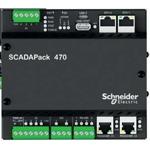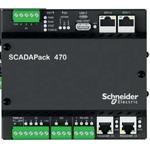

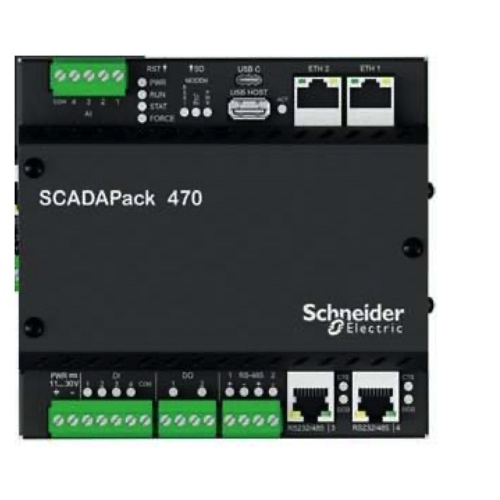
SCADAPack 470

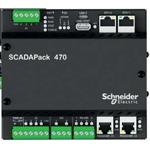
The SCADAPack™ 470 Smart RTU is a next-generation remote terminal unit designed for advanced monitoring, control, and automation in distributed SCADA systems. Combining RTU communications with PLC-level processing and data-logging capabilities, the SCADAPack 470 is optimized for remote operations in demanding environments such as oil and gas production, water and wastewater facilities, and energy infrastructure.

The SCADAPack 470 is available in configurations that include one open collector output and up to ten dry contact outputs, allowing flexible control of field devices such as relays, valves, and motor starters. These output options support a wide range of control strategies while maintaining reliable operation in electrically noisy or harsh field conditions. The platform is designed to support autonomous control, continuous monitoring, and efficient system expansion.

Configuration and application development are streamlined using SCADAPack RemoteConnect software, which integrates configuration, diagnostics, and logic development into a single environment. The built-in Logic Editor is based on EcoStruxure™ Control Expert (Unity Pro) software components, enabling code reuse and interoperability between Schneider Electric Modicon PLCs and SCADAPack Smart RTUs. The SCADAPack 470 also supports ready-to-use solutions such as Reallift™ artificial lift applications and the Realflo™ Oil and Gas Flow Computer, reducing engineering time for common industry use cases.
Found 4 items
Normally In Stock
SCADAPack TBUP470-UA50-AA00S (470 Series) Class 1 Div 2
Free U.S Ground shipping
$2263.79
$1886.49
Normally In Stock
SCADAPack TBUP470-UA50-AA03S (470 Series) Class 1 Div 2
Free U.S Ground shipping
$2997.73
$2498.11
Normally In Stock
SCADAPack TBUP470-UA50-AA06S (470 Series) Class 1 Div 2
Free U.S Ground shipping
$3595.34
$2996.12
Normally In Stock
SCADAPack TBUP470-UA50-AA0TS (470 Series) Class 1 Div 2
Free U.S Ground shipping
$4323.78
$3603.15

SCADA: Learning the Basics

Supervisory Control and Data Acquisition (SCADA) systems are a combination of both hardware and software that allows monitoring of various devices that provide information about specific environments or processes. This information is transmitted through logic controllers, or other smart devices, and is sent to software interfaces known as an HMI, where the information is displayed in a way that individuals can read and interpret the data. SCADA is not only used for monitoring, it is also used for control. Through SCADA, it is possible to manipulate, move, or change the state of certain devices on the network. For example, it is possible to initiate a command through the HMI software that will energize or de-energize a solenoid valve, thus changing its state. In most scenarios, there are dozens, hundreds, or even thousands of points throughout a location or multiple locations that are being monitored and controlled through SCADA. SCADA systems can be found in many different industries such as telecommunications, water and wastewater, energy, oil and gas refining and transportation. These systems can be used to monitor and control only a few simple points, or can be used in massive energy plants where tens of thousands of data points are being interpreted and controlled every minute.

Hardware used in SCADA systems include: 

  • PLCs, which can act as a bridge between the hardware and software, as well as providing data transmission and network communications.
  • Field monitoring and control devices, such as limit switches, temperature transmitters, pressure transmitters, solenoid valves, chemical monitoring devices and motor starters.

Software used in SCADA systems include:

  • HMI or Human Machine Interface software receives data throughout the system and organizes it in a way that can be easily interpreted. It can also provide control based on the information it receives.