
Potential Collective Terminal Blocks
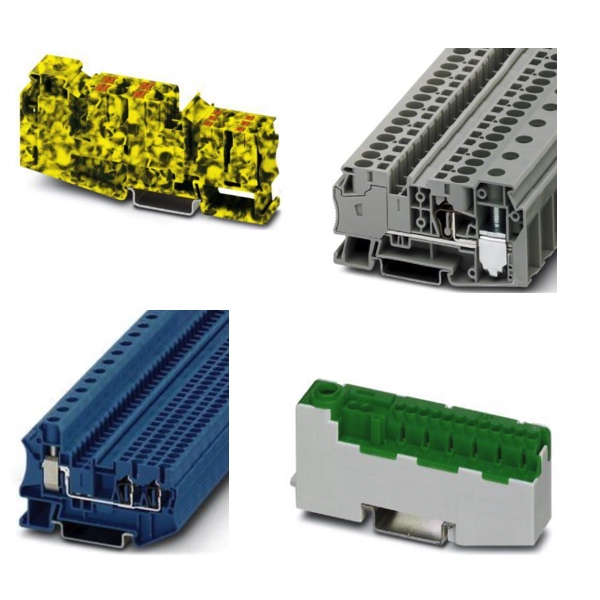
Potential collective terminal blocks are designed to distribute a single incoming electrical potential to multiple outgoing connections in a clean, organized, and reliable manner. Commonly used in industrial control panels and automation systems, these terminal blocks simplify wiring by allowing multiple conductors to share a common voltage or signal reference. RSP Supply offers a wide selection of potential collective terminal blocks featuring screw, spring cage, and push-in connection technologies.
These terminal blocks are built with an insulated housing, internal conductive strip, and clamping mechanism to securely terminate and distribute conductors. Depending on the design, wires can be connected using screw connections, spring cage connections, or push-in technology, often requiring ferrules for solid termination. Their modular DIN rail mounting allows blocks to be easily added, removed, or rearranged without disturbing adjacent wiring, making them ideal for systems that require flexibility during maintenance or future expansion.
Phoenix Contact's potential collective terminal blocks are a common solution in this category, featuring hybrid designs that combine different connection technologies within a single terminal block. Many models include a high-capacity 35 mm² feed-in using a screw connection, while the distribution side utilizes push-in or spring cage connections. This approach supports fast internal panel wiring while maintaining versatile, service-friendly connections on the field side. The wide variety of configurations allows control panel builders to create application-specific, space-efficient designs.





FAQs
Q: What is a potential collective terminal block?
A potential collective terminal block distributes a single incoming voltage or signal to multiple outgoing connections, helping organize and simplify control panel wiring.
Q: What connection types are available for potential collective terminal blocks?
They are available with screw connections, spring cage connections, push-in connections, or hybrid designs that combine multiple connection technologies.
Q: Why are potential collective terminal blocks used in control panels?
They reduce wiring complexity, improve organization, and provide reliable, semi-permanent connections that are easy to modify during maintenance or system changes.
Q: What is a hybrid terminal block?
A hybrid terminal block uses different connection technologies in one block, such as a screw-connected feed-in and push-in or spring cage distribution connections.
Q: How are potential collective terminal blocks mounted?
They are typically mounted on DIN rails, allowing for quick installation, removal, and reconfiguration within control cabinets.
Why Buy Potential Collective Terminal Blocks from RSP Supply
RSP Supply offers a comprehensive selection of potential collective terminal blocks with screw, spring cage, and push-in connection types for industrial control and automation applications. Our product lineup supports flexible power distribution, clean panel layouts, and reliable long-term performance. Customers rely on RSP Supply for trusted manufacturers, detailed technical specifications, and knowledgeable support when selecting terminal block solutions for control panel design.