

Transcript:
[0m:4s] Hi I'm Josh Bloom, welcome to another video in the RSP Supply education series. If you find that these videos are helpful to you, it certainly helps us out if you could give us a big thumbs up and subscribe to our channel.
[0m:16s] In today's video we are going to continue on in our brief video series in which we have been discussing how safety relays function and in what types of situations they are used in.
[0m:27s] As mentioned in our last video when you understand the basic hardware components that are used and how they function, understanding the safety relays becomes much easier.
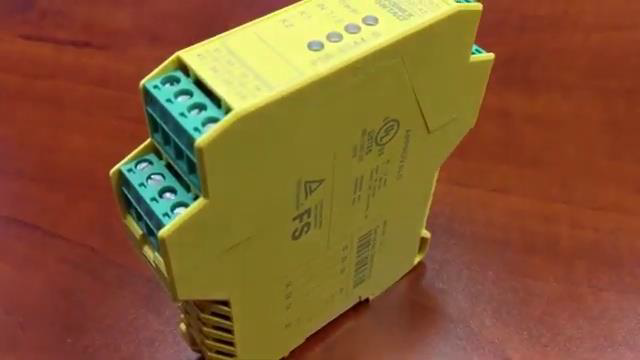
[0m:39s] In our last video, we focused on the type of contacts that are commonly found in safety relays which are known as force guided contacts.
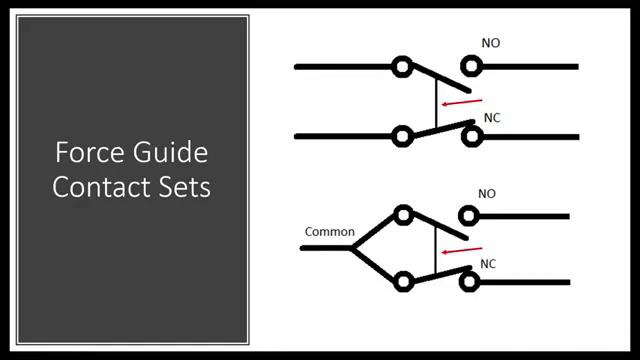
[0m:49s] As a quick recap, these contacts are mechanically connected to another, and because of this connection, the normally closed and normally open contact can never be closed at the same time.
[1m:1s] If you haven't already seen that video, we will link it in the description below, as it has a ton of valuable information that will help you better understand the safety relay functionality.
[1m:13s] For the purpose of this video, we want to focus on some other hardware features that are common to safety relays that enable additional safety functionality.
[1m:23s] We hope that by the end of this video and this series that your understanding of safety relays has grown,
[1m:30s] and that you have the confidence to use troubleshoot and select a safety relay. So let's get to it.
[1m:37s] In traditional relays when a coil is energized, the contacts in that relay will change state.
[1m:44s] So a normally open contact will close when energized,
[1m:48s] and a normally closed contact will open when energized.
[1m:52s] This works differently in safety relays.
[1m:55s] Instead of simply providing the correct power to the relay to enable the contacts to function,
[2m:1s] safety relays rely on multiple conditions to be met at the same time in order for the relay to function.
[2m:10s] This reliance on multiple conditions increases the safety factor of the relay.
[2m:16s] In other words, the more conditions that are required to be met, the harder it will be for the relay to become energized, therefore increasing the level of safety it provides.
[2m:28s] Even if one condition is not met, the relay will not energize.
[2m:33s] Conversely, if the relay is already energized, it will only require one of the several conditions to change states
[2m:43s] in order to deenergize the relay and return the contacts to their normal positions.
[2m:50s] Let's use an example to better illustrate this concept.
[2m:53s] Let's assume you have a safety relay that is wired to a motor,
[2m:58s] the normally open contact on the relay, and a separate safety indication light that is always on the normally closed contact on the relay.
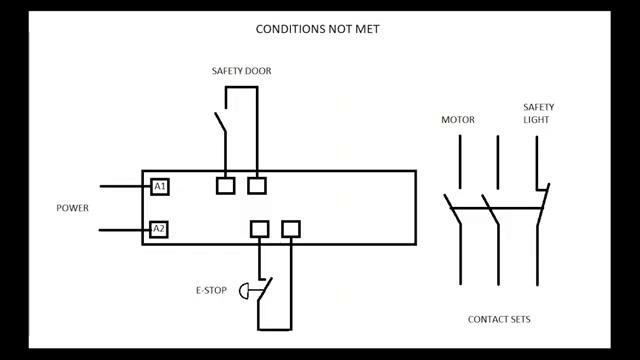
[3m:7s] This light will only turn off
[3m:10s] when the relay is energized, which in turn will power the motor.
[3m:14s] In order for you to provide power to this motor, several conditions will first need to be met. First and foremost, power must be provided to the relay.
[3m:24s] This power can come straight from a power distribution circuit with no control,
[3m:29s] or it can also be provided through a controlled circuit such as a PLC, another relay,
[3m:36s] a closed contact from something like an E stop safety door, or other contact closing methods.
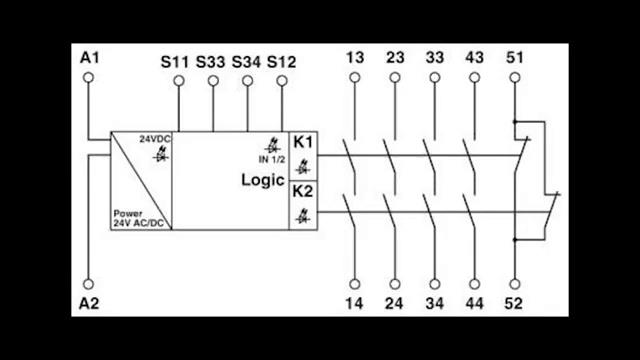
[3m:43s] Once the safety relay has power, it will then have more conditions that need to be met.
[3m:49s] How many conditions will depend on the safety relay.
[3m:53s] These conditions typically consist of several open circuits that need to be closed with a simple set of dry contacts in order for the relay to fully energize and change the states of the contact set.
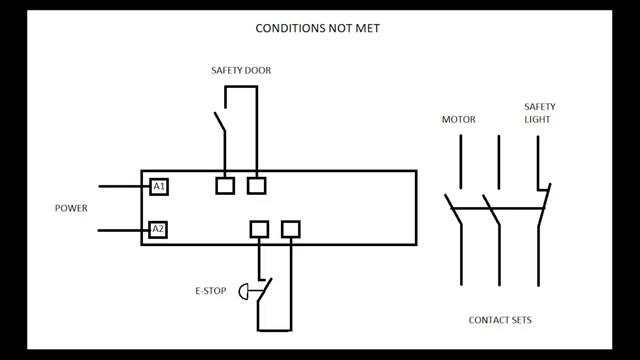
[4m:7s] These open circuits can be wired to just about anything.
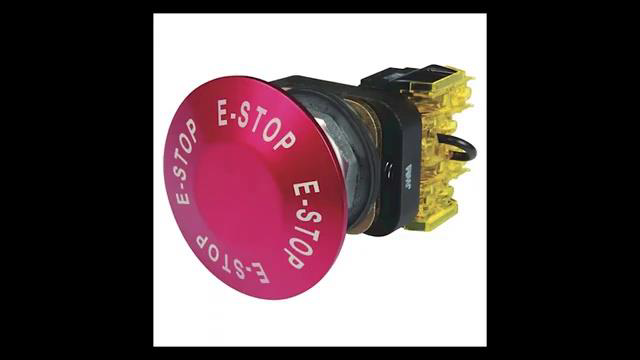
[4m:11s] So, using our example, one of the circuits could be wired to an E stop that when depressed will open the circuit, thus deenergizing the relay.
[4m:20s] One of the other circuits could be wired to a safety door that requires the door to be shut in order to close the circuit.
[4m:27s] So if this were the case and we wanted to fully energize this relay, three conditions would need to be met. First, the relay needs power.

[4m:36s] This can be with a controlled circuit or no control.
[4m:39s] Next, the safety door would need to be shut in order to close that circuit.
[4m:44s] Lastly, you would need to ensure that the E stop is not depressed or that it is in its ready state. In this position, it will enable a closed circuit.
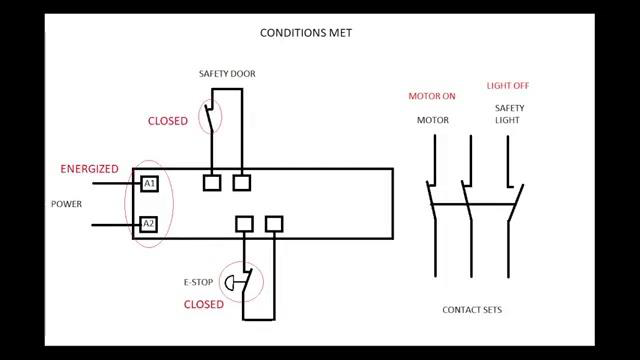
[4m:55s] At this point, we will have met all three conditions of the safety relay.
[5m:0s] Once this happens, the contacts will change state. Or in our case, the motor will become energized and our safety indication light will turn off.
[5m:9s] Not all safety relays function the same way. But the majority of them have this type of functionality.
[5m:16s] These condition requirements, coupled with force guided contacts, enable safety relays to provide a nearly fail-safe working environment.
[5m:26s] Without these types of relays, it would be much more difficult to provide the level of safety that is needed in many of the industrial and manufacturing environments that they are found in.
[5m:37s] Again, with some basic understanding, you can better understand how these devices function and help to keep our workers safe.
[5m:46s] In the last video in this series, we are going to provide a real life mockup
[5m:51s] of a fully functioning safety circuit so that you might continue your understanding of how these sometimes complex circuits actually function.
[6m:1s] So make sure to follow along as we continue to learn more about these critical safety devices.
[6m:8s] For a full line of safety relays and thousands of other products, please go to our website. For more information or other educational videos, go to RSPSupply.com, the Internet's top source for industrial hardware. Also, don't forget: like and subscribe.