

Different_Thermorcouple_Types.pdf
Transcript:
[0m:4s] Hi, I'm Josh Bloom, welcome to another video in the RSP Supply education series
[0m:9s] If you find that these videos are helpful to you, it certainly helps us out if you could give us a big thumbs up and subscribe to our channel.
[0m:16s] In today's video, we want you to talk more about thermocouples.
[0m:20s] More specifically, we want to talk about the different thermocouple types that exist today.
[0m:26s] If you have not already seen our other video in which we cover the basics of thermocouples, we will link that video in the description below.
[0m:35s] For the purpose of this video, we will talk about what makes each type of thermocouple different from one another, and in what types of environments each type can be used in.
[0m:47s] We hope that by the end of this video, you have a solid understanding of what each type of thermocouple might be used for, and why.
[0m:56s] With that said, let's look at the different types of thermocouples. Let's first run through a list of the main thermocouple types that you might be able to find today they are types J-K-T-E-N-R-S and B.
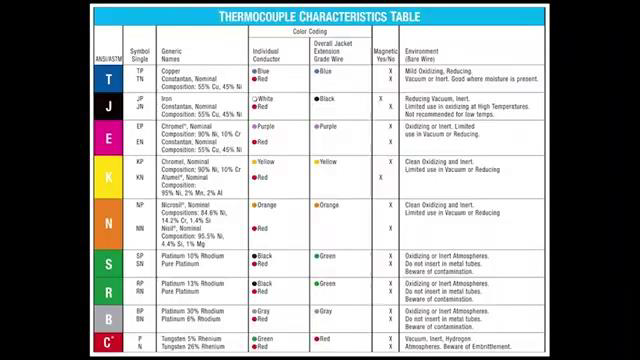
[1m:13s] Each of these thermocouple types have different characteristics and intended use cases.
[1m:20s] As a quick reminder: thermocouples work by using two dissimilar metals and two junction points, a hot junction and a cold junction that will enable a voltage reading that can be translated to a temperature range. Now, let's look at each type in more detail to learn how they differ and where they might be used. Type S thermocouples consist of a platinum Rhodium, Rhodium metal combination and have a temperature range between 1800 and 2640 degrees Fahrenheit.

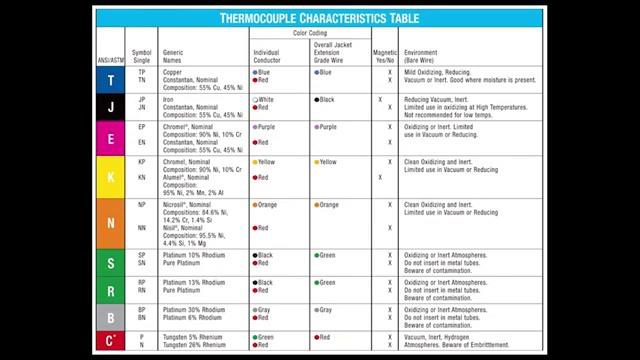
[1m:53s] Type S thermocouples can be continually used at temperatures up to 1450 degree Celsius. They can also withstand short duration excursions up to 1650 degrees Celsius. They are commonly housed in a thorough well to protect them in harsh environments. Type R thermocouples also consist of platinum Rhodium, Rhodium metal combinations and have a temperature range of between 1600 and 2640 degrees Fahrenheit.

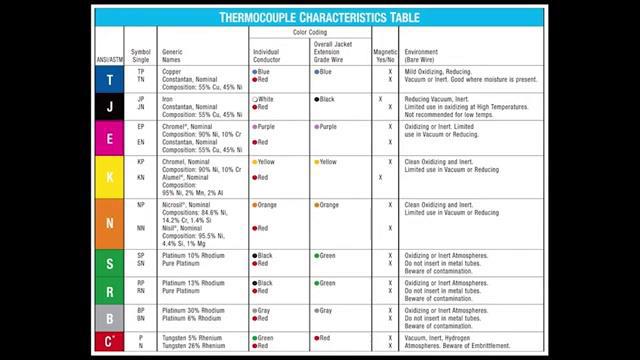
[2m:21s] Type R thermocouples cover similar applications as type S, but offer improved stability and a marginal increase in range. Consequently, type R thermocouples tend to be used instead of type S. Type T thermocouples consist of a copper and copper nickel metal combination and have a temperature range between negative 75 and 700 degrees Fahrenheit.


[2m:46s] Type T thermocouples are rarely used in industrial applications and are used more in lab environments and prototype applications. Type K thermocouples consist of a nickel Chromium nickel aluminum metal combination and have a temperature range between 32 and 2300 degrees Fahrenheit.
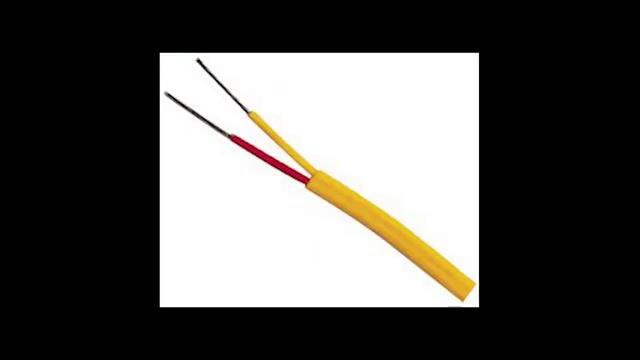
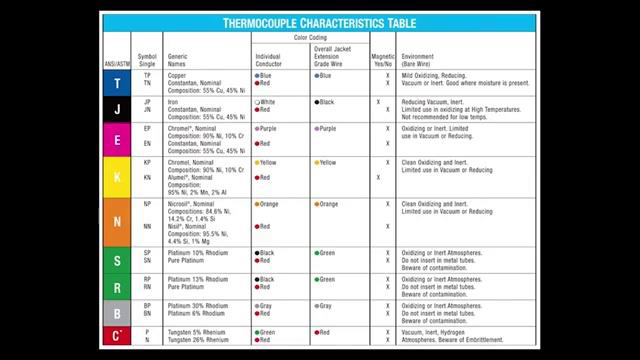
[3m:8s] Type K thermocouples are the most widely used thermocouple in the oil and gas and refining industries due to their wide range and low cost. They are occasionally referred to as a Chromel/Alumel thermocouple.
[3m:22s] Type N thermocouples consist of a Nicrosil Nisil metal combination and have a temperature range between 32 and 2300 degrees Fahrenheit.
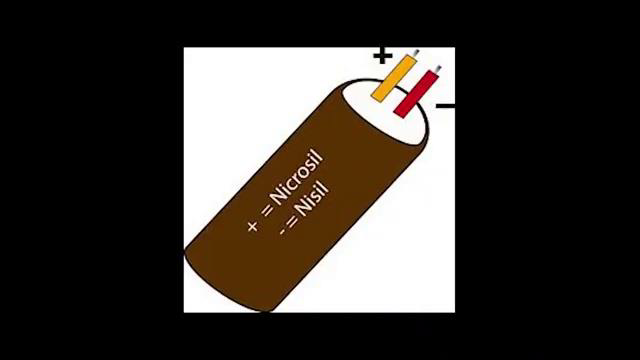

[3m:32s] Type N thermocouples have similar temperature ranges to type K, but offer better repeatability in the 300 to 500 degrees C range. It can be less expensive than type R and S therefore provide good alternatives.
[3m:47s] Type J thermocouples consist of an iron copper nickel metal combination with a temperature range between 32 and 1400 degrees Fahrenheit.