

Understanding_Wiring_Diagrams_-_Part_3_Power.pdf
Transcript:
[0m:4s] Hi I'm Josh Bloom, welcome to another video in the RSPSupply education series. If you find that these videos are helpful to you, it certainly helps us out if you could give us a big thumbs up and subscribe to our channel.
[0m:16s] In today's video, we are continuing on in our brief series in which we are learning to understand wiring diagrams, specifically related to control, so that you might be able to read and or design your own electrical control system.
[0m:30s] In our last video, we talked about many of the most common symbols that are used in electrical drawings and how to identify those symbols.
[0m:39s] By being able to identify all of the various symbols, you will have a much better chance of being able to successfully read and draw an electrical diagram.
[0m:49s] For the purpose of this video, we want to start by talking about a specific section of an electrical wiring diagram, which is the main power distribution portion of the drawing.
[1m:1s] Just a reminder, these videos are focusing mostly on wiring diagrams you might see for an industrial control panel. However, most of the principles can apply to any type of electrical drawing.
[1m:15s] Within the main power portion of the panel, we will focus on things such as how to properly distribute power to the various devices in your circuit, and how to draw everything so that it is easy to understand. Keep in mind the items we discuss today are meant to be a guide and are not intended to replace proper electrical design education.
[1m:38s] It is important to consult with an electrical engineer or qualified person to ensure the system you design meets all electrical codes and will function safely and as expected. With that said, let's look at some schematics so we might better understand the main power distribution portion of a drawing.
[1m:57s] So, if you'll remember from our last video, we talked about the different symbols you'll see in electrical diagrams. As mentioned before, in this one we're going to focus more on power and how to understand and draw the different power diagrams you might see in various electrical drawings, focusing more on power distribution and how that power is fed to the different devices that we might see. We'll look at a few different examples, and hopefully by the end of this you'll have a better understanding of how you might draw, if that's something you're working on, or how you might just simply be able to read or better understand one of these diagrams. So, we'll go ahead and go to our first example here.

[2m:40s] And in this particular diagram, you can see we've got 240 volt circuits that are feeding this particular system. Again, if you'll remember from our last video, we talked about the different symbols that we'll see. Here you can see the symbol for some circuit breakers. We have two 2-pole 30 AMP circuit breakers. The boxes simply represent terminal blocks.
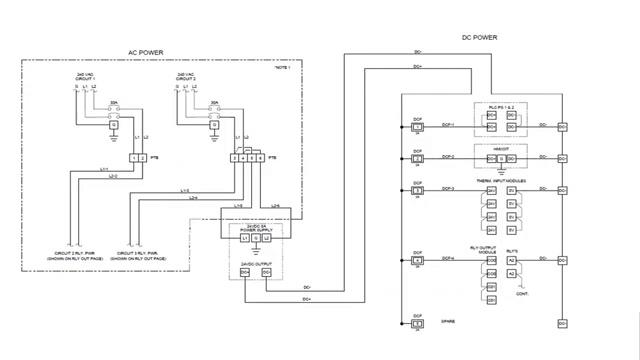
[3m:4s] And then this little box here is representing a power supply. So again we have, just so you understand, we have AC power here,
[3m:12s] we have DC power. On our AC power on this particular circuit, we have 240 volts being fed to a 30 AMP circuit breaker down some terminal blocks that are being jumpered. So, they're going to multiple locations. Part of it is going out to a relay power circuit, probably for some control,
[3m:30s] and then it's being jumpered over to, it looks like, a power supply. Five amp power supply, which is going to provide DC power for a different type of power for our system. So if we follow DC over,
[3m:44s] we'll see that we're powering a PLC,
[3m:48s] and in this case there's still double block. This is represented as a fused terminal block. So, this is a regular terminal block, this is a fused terminal block.
[3m:56s] You see a little 2A, that's a two AMP terminal block powering the PLC.
[4m:1s] We're also powering an HMI, and then we're powering, it looks like, some thermal input modules. This is for some control. So, this is a good example of a power circuit that uses both AC and DC. And most examples we look at today you're going to see something similar where we have both AC and DC and we're converting that with the power supply.
[4m:19s] Let's go ahead and look at our next line.
[4m:21s] In this example, you see again, we have AC and DC power. And this one's a little different in that we're feeding 120 volts in some terminal blocks, one of those is fused with a 10 AMP fuse block,
[4m:32s] and here we have a power fail relay. This is actually a relay A2 A1. This is a power fail relay in this particular case. That's just monitoring our utility power. If we lose power, it'll alert the PLC and the operator can know if they've lost utility power.
[4m:48s] We also have utility power being fed to an outlet which is being used by a UPS, an AC UPS. So, anything downstream of this UPS, whether it's AC or DC, is going to be protected by this battery backup for a certain amount of time.
[5m:3s] On this UPS, you see we have a power supply,
[5m:8s] providing our DC power, which is located over here. Coming off that DC power, again we have some circuit breakers, several two AMP circuit breakers.
[5m:15s] We're powering a PLC, another PLC, and a network switch. Again, you can see various symbols here, but the most important thing I want you to look at is how we're feeding power.
[5m:27s] We're feeding our live and our neutral,
[5m:29s] our live and our neutral, our outlet, our UPS. It's really quite simple if you can just follow these lines, understand what they mean, read the labels: DCB, that's DC breaker one, DC breaker two. Very simple to understand once you understand the basic terminology. Let's go ahead and look at another.
[5m:47s] This one, again, is similar in that we have both AC and DC power but a little more going on here.
[5m:53s] We can have 120 volts as our main feed going to a 15 AMP circuit breaker. In this case, we have a surge protector. So any surge that comes into this particular system is going to protect anything downstream of that protector.
[6m:8s] And then, from there, we have our ACL or L1 coming and feeding a light through a door switch.
[6m:15s] Feeding again, a relay. This is drawn a little bit differently but it's a power fail relay, and then also feeding, again drawn a little differently, a duplex receptacle,
[6m:24s] that a UPS is being plugged into and that is feeding the rest of our AC circuit here and up here.
[6m:31s] In that circuit, we have a power supply and a PLC which obviously takes AC power.
[6m:36s] Coming over to our DC, we'll run our lines here. We have a DC positive leg and our DC negative.
[6m:42s] We have several breakers, mostly two AMP breakers feeding a switch, a touchscreen,
[6m:47s] AI IO power. This is an analog input IO power, for some control.
[6m:52s] And DIO is digital input or output power, again, for some control. So, here you see, we have three different examples that we've looked at,
[7m:3s] all somewhat similar in the way that they distribute power. We have main feed,
[7m:8s] and then we're feeding several different devices here: a light, a relay, a receptacle, a power supply, and then a PLC. We're feeding all these devices in a very similar manner. So, if you understand the way that power is distributed, you have a much better understanding how these diagrams function, you'll be able to read them, and if the scenario calls for it, you'll be able to draw these types of diagrams and feel confident in doing so.
[7m:38s] As you can see, there is a lot that can go into the power distribution portion of a drawing. It is important to make sure that you are following all electrical codes and to make sure that you are consulting with an electrical engineer or someone with the experience needed to ensure your design is sound.
[7m:55s] It should always be a top priority to create an electrical design that is safe, first and foremost, with proper function a close second.
[8m:3s] For a full line of industrial control panel hardware and thousands of other products, please go to our website. For more information or other educational videos, go to RSPSupply.com, the Internet's top source for industrial hardware. Also, don't forget: like and subscribe.